SUNSET LISTENING WINDOW
Checking season…
Your evening forecast
The sunset window appears when the regional outlook is ready.
Awaiting evening weatherMichigan Woodcock Sky Dance Forecast
Hear the timberdoodle’s peent, twittering climb and chirping fall, then find the spring evening, the twilight moment and the edge of the woods to hear it yourself.
Checking Saginaw Bay & Bay City…Sunset timing and NWS evening weatherExplore six documented viewing areasThe recordist removed about 40 seconds of silence while the bird was out of microphone range, so the gap at 0:27 is an edit, not a pause in the flight. The three stage clips are excerpts: peent from a second bird, twitter and chirps from this performance.
From a small opening the male gives a short, buzzy, nasal peent every few seconds, often turning between calls.
Listen for: One flat, nasal note, then a pause of a few seconds.
Recording: steve b, CC0He launches and climbs in widening circles, often a few hundred feet up. Air rushing through three narrow outer wing feathers makes the twitter. It is not his voice.
Listen for: A fast, even, mechanical twitter that builds as he climbs.
Recording: © Evan Raskin, CC BY 4.0At the top he zigzags back down with liquid, chirping notes, lands near where he started, and soon begins peenting again.
Listen for: Sweet, irregular chirps falling toward the ground.
Recording: © Evan Raskin, CC BY 4.0Choose a Michigan region. The tool measures conditions for listening, not the probability of a woodcock sighting.
The sunset window appears when the regional outlook is ready.
Awaiting evening weatherCompare the evening temperature, wind and rain around the actual dusk window — not arbitrary 8–11 p.m. conditions.
Switch between six documented historical walk venues and nine regional weather points. Venue pins show an approach or approximate property point, never the birds’ exact display ground.
Six Michigan places with documented woodcock walks. Choose a site to see historical evidence, the actual published meetup or entrance, and what still needs confirmation. None are certified as independently open after sunset.
No dated spring 2027 Michigan woodcock walks are in the verified organizer feed yet. Historical venues below remain useful planning leads, not confirmed 2027 programs.
Official organizer listings only. A walk is not a bird sighting, a ticket reservation or independent authorization to enter after dusk. Listings can change; follow the original organizer link.
Public state forest / GEMS · Near West Branch / Gladwin
Michigan DNR and Ruffed Grouse Society hosted dusk woodcock walks in April 2025 and 2026. This is past event evidence, not a current bird observation or automatic permission to return.
Read the historical event sourceBowmanville Road at Lame Duck Truck Trail. The GPS point is the DNR-published 2025 meetup, not a guaranteed place to see a bird.
The DNR specifically published this road intersection as the walk meeting point. Check the GEMS map and current parking signage before leaving your car.
Trails may be muddy and uneven; DNR described the 2025 organized walk as not ADA-accessible.
Public GEMS land; dusk entry, seasonal gates and parking restrictions have not been independently confirmed for self-guided visits.
Pin meaning: DNR-published historical meetup. No route across sensitive nesting or display habitat is inferred.
Do not assume event permission carries over. Even a public game area may have posted parking restrictions or a special closure. County parks and nature centers often require an organized walk for after-hours entry. Check agency maps, regulations, current construction notices, and permitted vehicle access before planning a dusk trip. No after-dark access or live display has been independently confirmed for these sites.
Five short snippets from the same real recordings. Play each one and choose the stage you hear. A good warm-up before an evening at the edge of the woods.
Everything to know once you are at the edge of the woods: the bird, the three sounds, the habitat, and how to watch without disturbing a display.
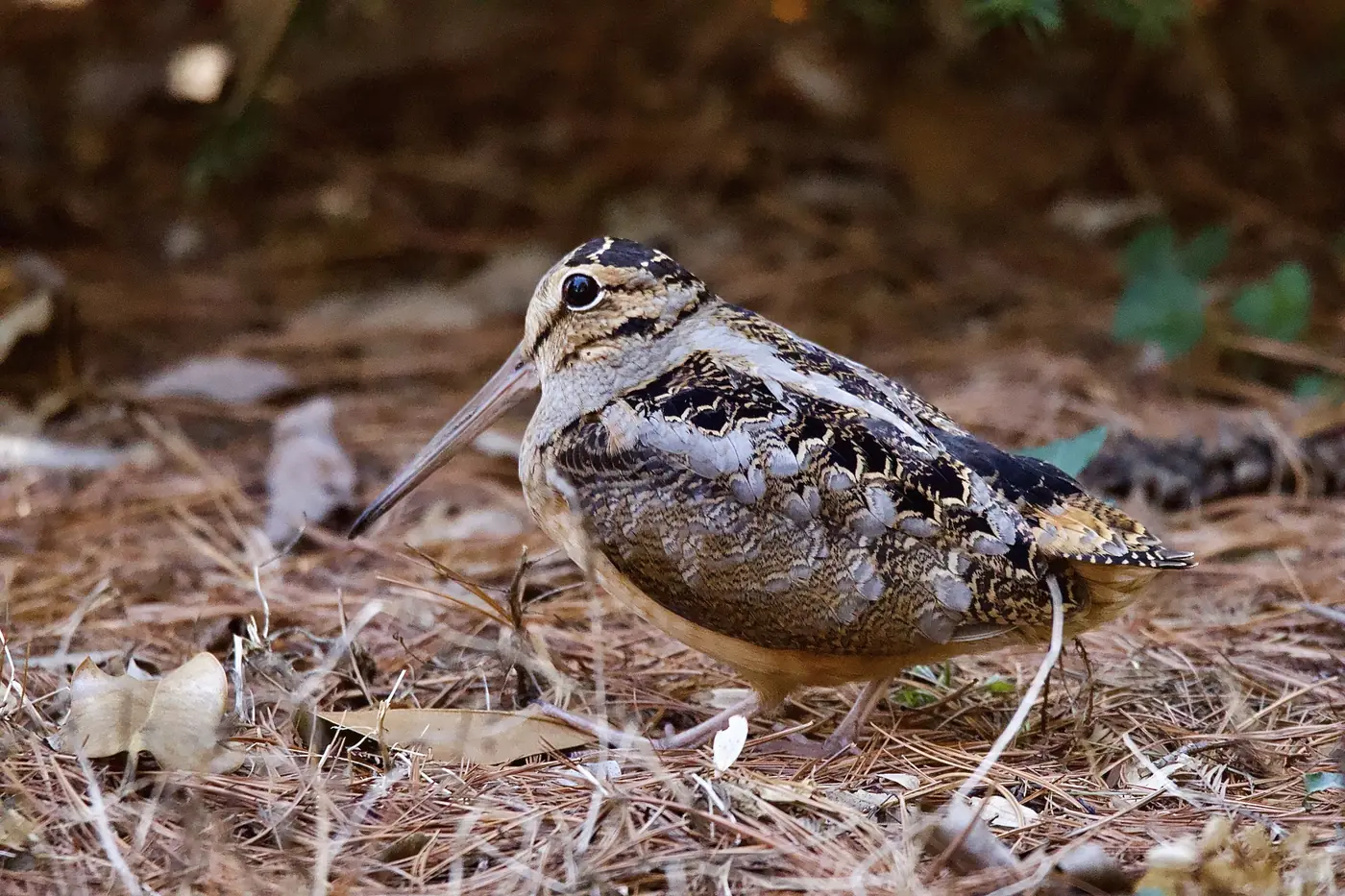
A nasal “peent” from the ground. Flat and buzzy, one note every few seconds from the same spot. That spot is the display ground.
A rapid, mechanical twitter overhead. Steady and even, rising and fading in waves as he circles. That is his wings, so you may hear it without any call.
Liquid chirps coming down. Irregular, sweet notes falling from the sky, then silence, then peents again from roughly the same place.
Sounds alone are not proof. Common nighthawks also give a nasal “peent,” but from the air and mostly from mid-May; frogs, insects and distant birds can mislead too. The full sequence, ground peents then twitter climbing then chirps falling, repeating every few minutes, is the reliable sign.
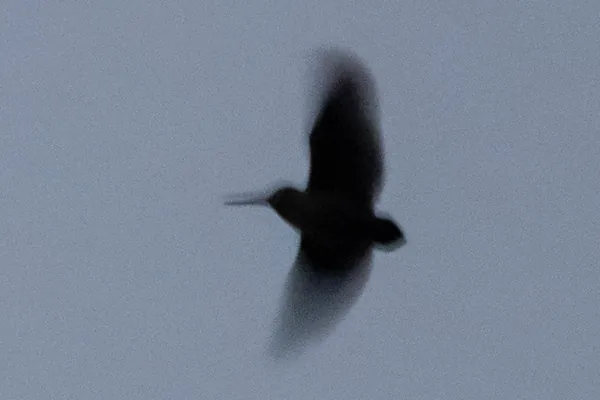
Watch the brightest sky. Face west or toward the afterglow and look up when the twitter starts; he is easiest to see as a small dark shape against it.
Hear him but can’t see him? Stay still. When the twitter stops, listen for chirps and watch the sky above the peent spot; he usually drops back within yards of where he took off.
Primarily in spring, often beginning as thaw and northbound migration progress in March or April. Displays can continue into May and later in northern areas. Local arrival and habitat matter more than any single statewide date.
USFWS singing-ground surveys start about 22 minutes after sunset with 75% or less cloud cover, or 15 minutes after sunset when more than 75% overcast. Arrive before sunset and listen through twilight. The display may begin earlier or last longer.
Listen for a buzzy, nasal peent repeated from the ground. A male then spirals upward, making twittering wing sounds, and descends with melodic chirps. Press play on the sky dance at the top of this page, try the Name that sound ear test, or use Cornell’s recordings to learn them before you go.
For listening, prefer evenings at or above 40°F with light wind and little precipitation. The U.S. Fish and Wildlife Service avoids surveys below 40°F, in strong wind or heavy precipitation. Weather suitability is not a guarantee that birds are present.
Scout small grassy openings next to damp young woods, alders, aspen, shrubs or forest edges. Use official DNR state game area maps to identify permitted public access. A weather region marker on this page is not a known display location.
A fall courtship forecast would be misleading. This page treats autumn and winter as off season and shows broad upcoming spring planning windows, not a fabricated live activity score.
Woodcock calls, courtship habitat and observation guidance are from the USFWS, Michigan DNR, Audubon and Cornell. Forecast weather comes from the National Weather Service. The season ranges and 0–100 weather-fit index are this tool’s explicitly non-validated planning heuristics. No real-time woodcock observation feed is connected.